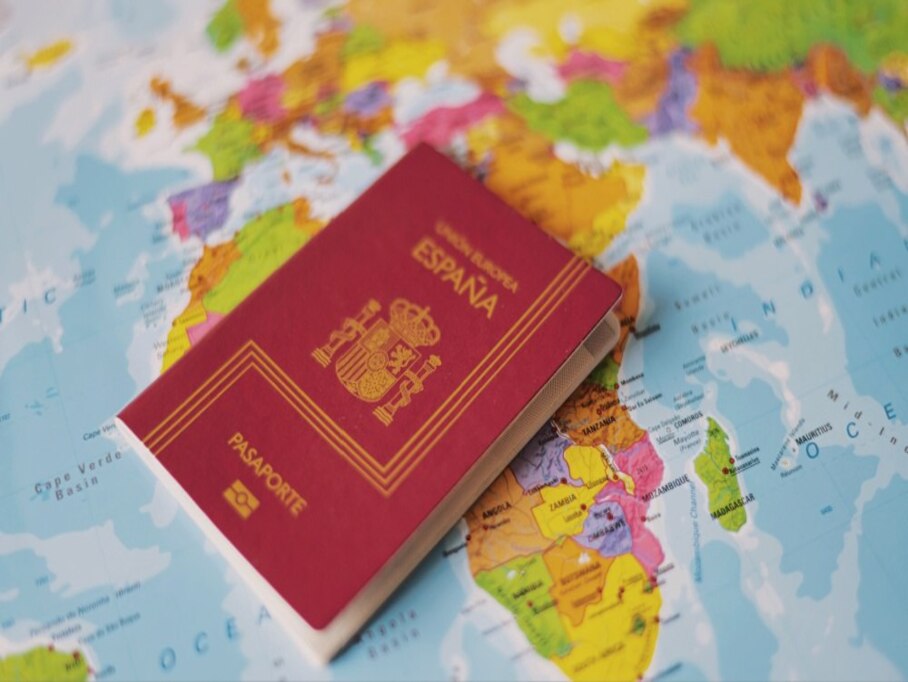

Remote work has firmly established itself as the new global standard. More and more professionals…
Spain Digital Nomad Visa: Requirements, Application Process, and Key Advantages
The Digital Nomad Residence (Digital Nomad Visa) was introduced in Spain under the Startup Law — Ley 28/2022 of December 21, 2022, which amended the Entrepreneurs Law (Ley 14/2013, de apoyo a los emprendedores). These provisions established a new status of “internacional teletrabajador” — an international remote worker, more commonly known as a digital nomad.
These laws create the official legal framework for obtaining the Digital Nomad Residence in Spain, defining the eligibility criteria for applicants, the procedure for submitting documents, and the timeframe for consideration (20 business days).
The Digital Nomad Residence offers two modalities:
- digital nomads can work either as employees (under an employment contract) or
- as independent contractors (under service agreements, for example, consulting services for foreign companies).
This division has significant implications:
- A digital nomad employed under a labor contract may only work for companies located outside of Spain; an independent contractor (self-employed digital nomad) may also provide services to Spanish companies, but such income must not exceed 20% of their total earnings.
- This distinction carries an important consequence related to social security. A digital nomad employed under a contract is subject to mandatory social security contributions — the employer must pay these contributions into the relevant funds. Since such a digital nomad will be working from Spain, the natural question arises: how will the requirement for social security coverage be fulfilled? Spain would not want to assume responsibility for such a worker (at least not in terms of social protection).
This issue is resolved through existing bilateral international agreements between Spain and a number of countries, including, for example, China, the United States, Moldova, Ukraine, Russia, and others. If the employer company is registered in one of these countries, all contributions paid by the company for the employee in the country of registration will be credited in the country where the employee actually performs their work.
Otherwise, the employer company will be required to register with the Spanish social security system and pay contributions on behalf of the employee within Spain. For many companies, such a requirement may be unacceptable, which is why an alternative option may be available for the digital nomad — applying for residence as an independent contractor.
- A self-employed digital nomad builds their professional activity on the basis of service agreements: they are not employed by a specific company and, if desired, can provide services to several organizations at once. (It should also be emphasized that, when applying for the Digital Nomad Residence, it is possible to present several contracts if, for example, the remuneration under a single contract does not meet the required minimum).
A particular feature of the Digital Nomad Residence for independent contractors is that, after approval, they must register as a sole proprietor (autónomo) in Spain. Thus, the independent contractor gains certain freedom from a specific employer, but assumes the obligation to manage their own accounting and reporting directly before the Spanish authorities.
Key benefits of the Digital Nomad residence
The Digital Nomad residence belongs to a special immigration regime, so all advantages of that regime apply to the Digital Nomad residence:
- the residence is granted immediately for 3 years;
- family members can be included;
- digital nomads are entitled to a fixed reduced tax rate of 24% regardless of income level;
- a strictly regulated processing time.
The Digital Nomad residence allows free movement within Spain and throughout the Schengen Area. It also provides access to the consulates of countries such as the USA, the United Kingdom, Japan, etc., from Spanish territory.
Documents required to apply:
- employment contract (or service agreement);
- certificate of registration of the employing company/client;
- university diploma / proof of relevant experience in the form of letters from other companies;
- criminal record certificate;
- health insurance;
- last 3 payslips (or service completion certificates/invoices);
- bank statement confirming receipt of salary for the last 3 months;
- company consent to work from Spain.
The required salary (or remuneration) level is determined by Spain’s minimum wage (SMI, Salario Mínimo Interprofesional). In February 2025 the minimum wage was €1,184 per month.
Income requirements for digital nomads in Spain
To obtain the Digital Nomad residence, you must show income of at least 200% of the SMI, i.e. at least €2,762 per month. This must be net income credited to a bank account after taxes, fees and commissions. Passive income, or, for example, rental income (including movable property) is not suitable, nor are statements about receiving salary or remuneration in cash — the immigration authority expects to see actual credits to a real bank account.
If family members are also applying, the required income increases in proportion to the number of family members: adding one family member requires an additional 75% of the SMI (i.e. +€888 per month), each subsequent member requires an additional 25% (i.e. +€296 per month).
Submission of documents
You can apply for the Digital Nomad residence from within Spain to the immigration authority called the Unidad de Grandes Empresas y Colectivos Estratégicos (UGE). In this case, the residence is issued immediately for 3 years.
If you cannot come to Spain to apply in person, you can apply at the Spanish Consulate at your place of habitual residence with the same set of documents; as a result, a 1-year Digital Nomad visa will be issued. After one year, the digital nomad can apply for residence from within Spain.
Frequently asked questions
- How long can I stay outside Spain without losing residence?
By law, for renewal of the Digital Nomad residence, absences of no more than 183 days per year are allowed. This usually leads to Spanish tax residency.
- Can digital nomad work be combined with running a business in Spain?
Digital nomads can open and register companies in Spain, but they cannot work in such companies as employees.
- What happens if the employer refuses to register with Spanish Social Security?
In that case, obtaining the Digital Nomad residence will not be possible. It is important to assess this early.
- Can I change employer or client while already holding Digital Nomad status?
Yes, you can, but you must notify the immigration authority and continue to meet the original requirements under which the residence was approved.
- How does the Digital Nomad visa affect tax residency in Spain?
The Digital Nomad residence almost certainly leads to Spanish tax residency: first, the residence requires staying in Spain for at least 183 days a year (otherwise it will not be renewed); second, obtaining residence implies the centre of professional interests is in Spain (since the work is performed from Spain). However, employed digital nomads may request application of the special tax regime under the Beckham Law.
- Can I switch from the Digital Nomad visa to another type of residence or permanent residence in Spain?
Yes, after 1 year of continuous residence in Spain under the Digital Nomad residence you can modify it to another type (e.g., residence and work authorization as self-employed). After 5 years of continuous residence in Spain you can apply for Long-Term Residence.
- How long does renewal take and what conditions must be met?
Processing at renewal takes no more than 20 working days. For renewal it is important to show that all conditions were met during the validity period and that absences from Spain did not exceed 183 days in each year.
- Can I obtain the Digital Nomad visa if I only work as a freelancer without a standing contract?
No. The absence of a contract will be an obstacle to obtaining residence, as it would breach legal requirements.
- Can rental or investment income be counted for financial sufficiency?
Investments, as well as rental income, cannot be considered proper proof of financial sufficiency.
- What activity restrictions exist for digital nomads?
There is no specific list of restricted activities — the key is that the work can be performed remotely. It is reasonable to assume that, for example, an airline pilot cannot obtain Digital Nomad residence because the essential work cannot be performed remotely.
- What if the application is refused? Is an appeal possible?
Yes. A refusal can be appealed within 1 month from the date of notification. The decision on appeal may also be challenged before the Supreme Court of Spain in Madrid.
Final note
Obtaining the Digital Nomad residence in Spain requires careful document preparation and attention to legal nuances. Our lawyers will help you through the entire process — from contract review and document legalisation to online filing and representation before the immigration authority.
Contact us to discuss your situation and receive personalised advice.
Related Posts